I Wrote Myself an App for Editing My Own Book
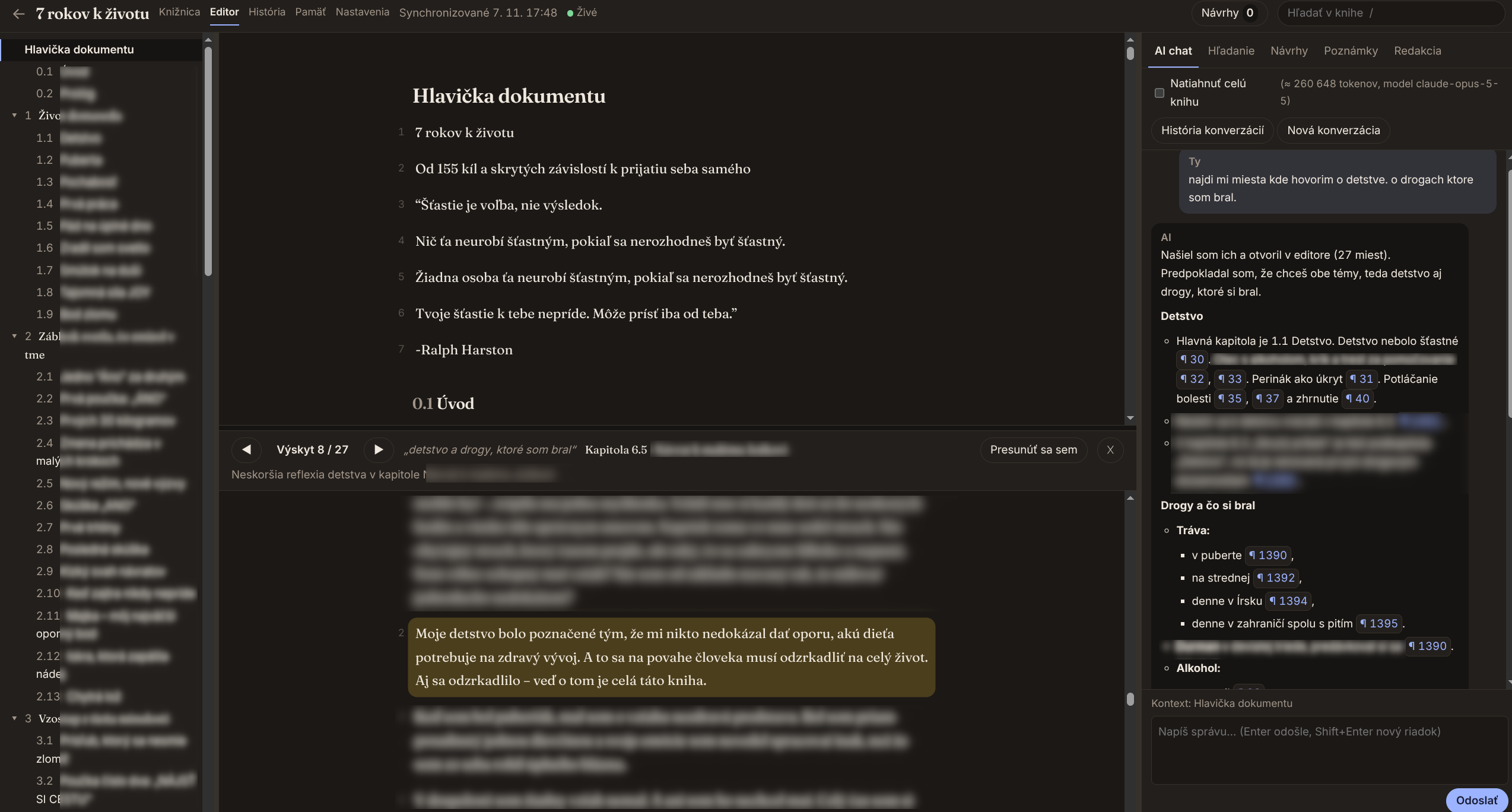
The manuscript of my autobiography 7 Years to Life is finished. My editor, though, won't start working on it until December. Until then, I'm doing the editing myself.
I'm a programmer, so I built my own tool for it.
The problem: you can't remember 300 pages
The printed manuscript runs to almost 300 pages. I wrote it in bits and pieces, at home, on the train and in cafés. There is no way to remember everything I wrote and where.
Yet in editing, that is crucial. When I want to rewrite a scene, I need to know whether I didn't already say the same thing two chapters earlier. Whether I'm repeating the same image. Whether I wrote something somewhere that contradicts it.
The ordinary search in Word is no help here. It only finds the exact word. But I write about the same thing differently every time.
Searching by ideas
I loaded the whole book into a so-called vector database. It sounds complicated, but the principle is simple.
Every part of the book is turned into a series of numbers that captures not the words, but the meaning. Parts that talk about something similar have similar numbers, even if they don't share a single word.
So when I type "find where I wrote about sadness", the app doesn't look for the word sadness. It looks for the places that are about sadness. It finds even the ones where the word sadness never appears.
For the author of an autobiography, that is a huge help. Suddenly I can see how one theme runs through the whole book. Where I give it too much space, where too little, and where I repeat it.
Notes and a history of changes
In the app, I write notes to every part of the book. What needs rewriting, what needs checking, what I don't like.
And I keep a history of every change. When I rewrite something and a week later realise the original was better, I can go back to it any time.
The editor's changes in one place
When my editor sends me a document with her changes, everything is in it at once: corrections in the text, comments in the margin, questions and suggestions. With the sample chapter, her advice got mixed up in the document and I had a hard time finding my way through it.
Now I upload such a document into the app and it shows me all the changes clearly. And I can search them by ideas, too. When my editor writes that one scene is too rushed, I can immediately find other places in the book where I make the same mistake.
Artificial intelligence can be used differently
When people hear artificial intelligence today, most of them imagine it writing texts for them. That you type "write me a book" and you're done.
That it can be used differently is not widely known. It helps me find my way around my own text. To find connections I would never hold in my head across 300 pages. The story, the experiences and the thoughts are mine. The tool just helps me work with them.
What comes next
Until December I'm working on the book on my own. Then my editor joins in and we carry on together.