I Let a Computer Draw My Own Life
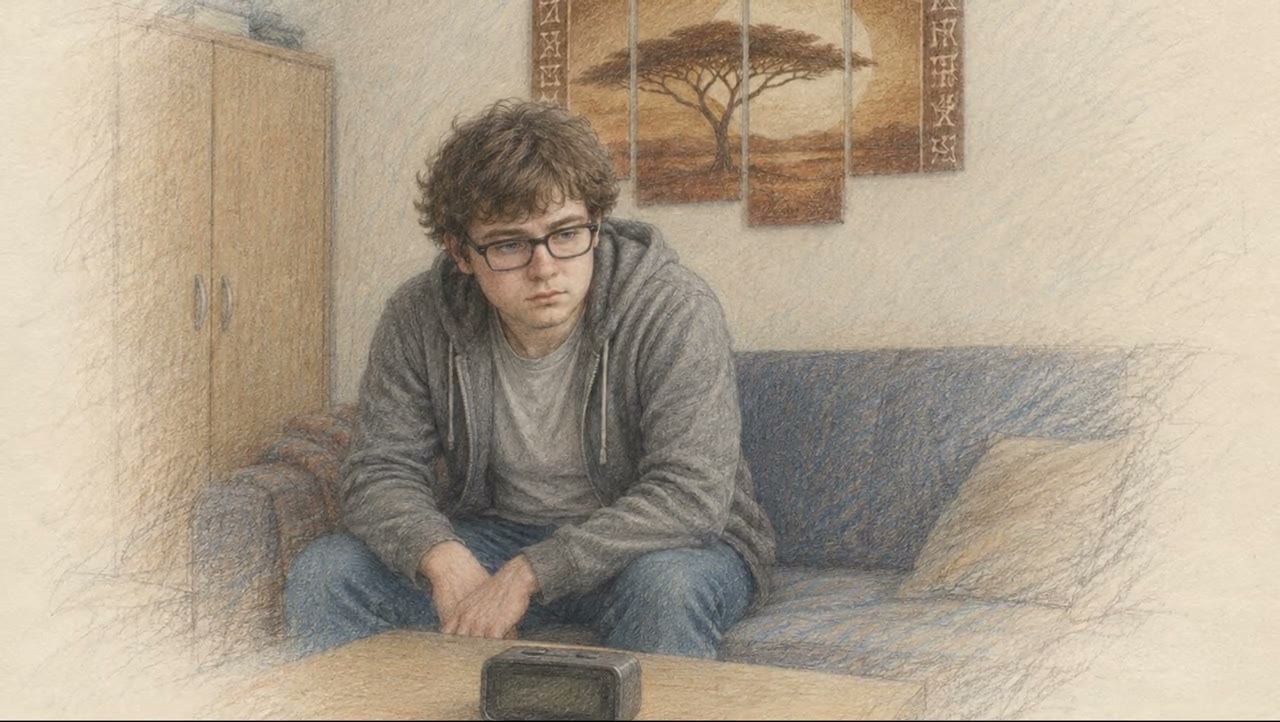
I wrote myself a program that takes a book and turns it into a film.
It reads the text, comes up with pictures for it on its own, then draws them, reads the whole book out loud and assembles a video out of the pictures and the voice. You then put it on like a bedtime story, except the story is your own book.
The sample above comes from my entry about the painting with the cuneiform writing. You know that text — it is the one about the sentence I had on my wall for years without knowing what it actually said.
I originally built it for something else, but it worked well enough that I am using it on Seven Years to a Life as well.
Where the catch is
Getting a computer to draw one nice picture is something anyone can do today. The trouble starts when you need six hundred of them and the same person has to be in every one.
And in my case it is worse, because that person is me.
Over the course of the book I pass through four different bodies. A skinny child. Then a man who got down to a hundred and ten kilos and thought he had it under control. Then a hundred and fifty-five kilos and a man who had stopped weighing himself. And at the end skinny again, but no longer the same as the first one.
If the program did not know that, it would draw me the same man in every picture. And that is worse than drawing nothing at all — the text would say one thing and the picture another.
What does not work
The first thing that occurs to you: I will draw one picture of myself and then show it to the computer as a reference.
It does not work. The computer redraws that reference a little every time it uses it. A slightly different nose here, eyes set slightly differently there. One at a time you do not notice, but after two hundred pictures you have somebody else entirely on the page. And the worst part is that you have no way of finding out when it went wrong.
It is like ten people whispering a sentence into each other's ear. What comes out at the end is nonsense and nobody knows who made it.
What works
I stopped showing it a picture and started describing it in words.
Every character of mine has two descriptions. The first is the face — its shape, the eyes, the eyebrows, the nose, the skin, the hair. That one never changes. The second is the body and the clothes, and that one changes depending on which part of the book we are in.
So the face stays mine, and the only thing that changes is how much I weigh.
It is exactly what an illustrator would do if they were drawing the book by hand. They would keep a sketch of the face pinned up so as not to forget it, plus a note on what that person looks like in this chapter. All I did was write it into a file.
The interesting part is that I could not tie those phases to age. Between the chapter where I weigh a hundred and ten and the one where I weigh a hundred and fifty-five there are two years, and I look like a different person. And between the first chapter and the last there are twenty years, and the weight is almost the same.
So not age. Where in the story I happen to be.
The parts I enjoyed most
I spent most of the time chasing mistakes that would never have occurred to me.
A plate instead of a watch. In one book an object was described as something about the size of a pocket watch. The computer doggedly drew it as a brass plate lying on a table. I wrote "small". Did not help. I wrote "pocket-sized". Did not help. What helped in the end was having to add, on every single picture, that the whole thing fits in a palm and that it never, but really never, lies on a table like a plate.
Children who age. An eleven-year-old child kept coming out as fifteen. Every time. It turned out not to be my fault — all these programs lean towards drawing children older than they should be. I had to spell out for it what not to draw: no adult proportions, but no toddler either.
The word "he". This one is my favourite. For one unnamed character the program noted down that it is referred to as "he". Two chapters later it ran into an entirely different unnamed character, also "he", merged the two and drew them with a stranger's face. The fix was a stupid one: I told it to ignore words like he, she, man and woman.
A voice that stops reading. The program that reads the book out loud sometimes simply stops in the middle of a paragraph. Or instead of reading the text it summarises it back to you in its own words, as though you had asked it a question. I had to deal with that by checking after it how much it actually read, and when something is missing, telling it to try again.
Words that are not allowed. Some pictures it refused to draw for me. Not because there was anything improper in them — it just did not like the words in the brief. In one case it was enough to swap out the words examination, nurse, uniform and shower curtain and everything was fine.
What it costs and how long it took
This is the part that tends to surprise people.
One picture comes to a cent and a half. One chapter, including twenty-five minutes of spoken word, costs about seventy-eight cents. The whole book — six hundred pictures and ten and a half hours of audio — came to eighteen euros.
The video itself is assembled on my laptop, and that costs nothing.
Reading the book out loud can even be done entirely for free. There are Slovak voices that are freely available, and Seven Years to a Life is read from start to finish by them. Zero euros.
I worked on it in the evenings and over weekends. The first version came together at the end of July in a single day, and back then it could only do the audiobook. The rest is four days' work in the middle of September.
The best part
That it works while I am not working.
In the evening I start a batch and go to bed. In the meantime the program reads the chapters, draws the pictures, reads the text aloud and assembles the videos. In the morning it is done.
From one overnight run: eighteen videos in an hour and a half. Then it waited ten hours to see whether another chapter would turn up, and since none did, it shut itself off.
I slept eight hours and in that time somebody illustrated a chunk of my book.
And one more thing I should not keep quiet about: I did not write that program entirely on my own. I wrote it with Claude Code. What was wrong, why it was wrong and how to do it differently — that was mine to work out. But the lines of code were not typed by a human hand.