For Ten Years I Thought the Painting Said Something Else
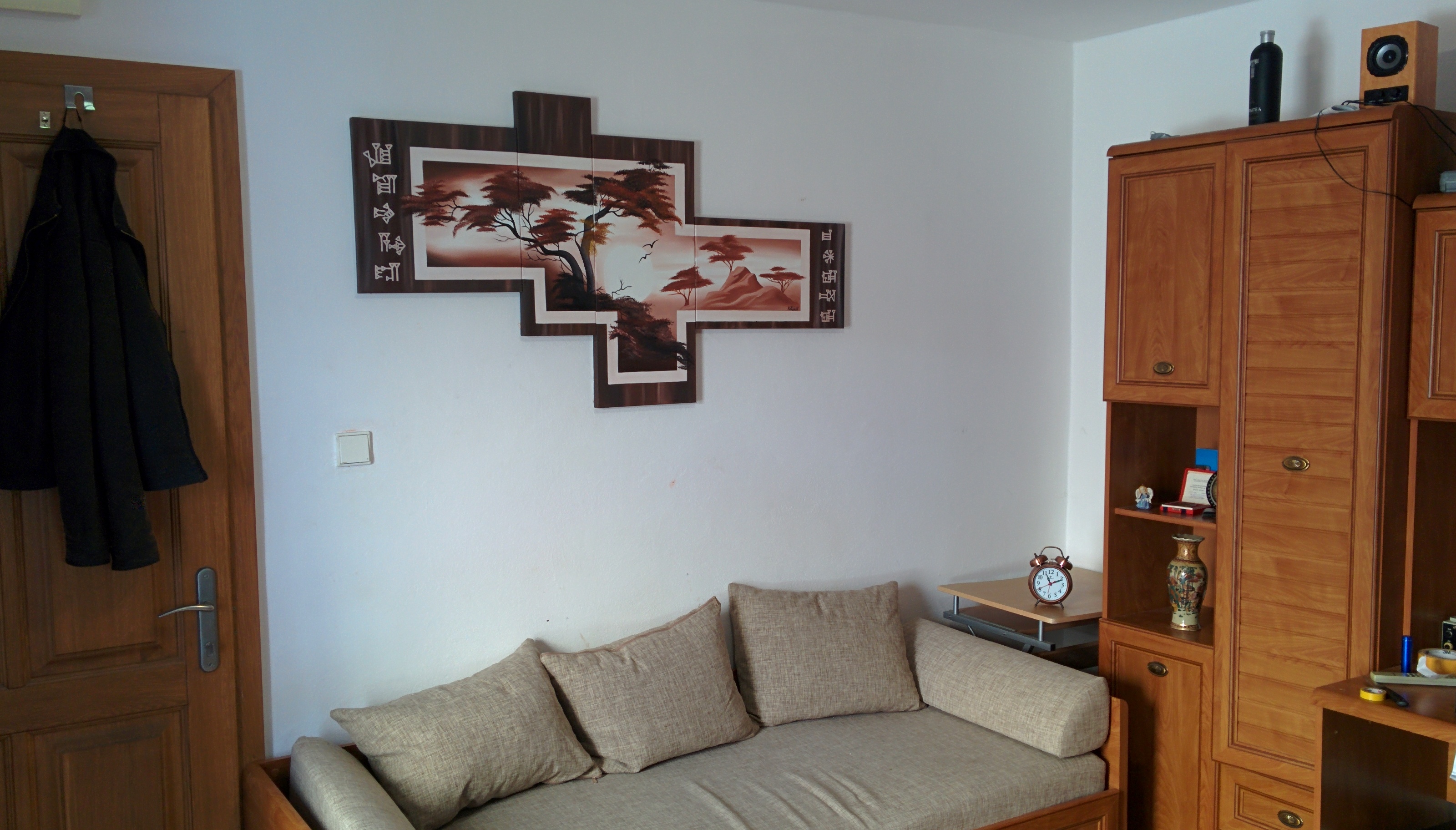
I took this photo on 8 June 2014. That is my room back then — the couch, the wardrobe, the alarm clock on the little table. And above the couch the painting I had had made a few months earlier.
There was nothing deep behind it. I wanted my place to look nicer. I found a local painter on Facebook, Zuzana Kolaďová, and wrote to her. She sent me sketches of what she could paint for me, and when I spotted a tree among them, that settled it. Bonsais had fascinated me forever, like probably everyone.
The reference picture had some sort of inscriptions along the edges, and right then it occurred to me to take it one level further. I don't want an ornament there, I want a sentence. And I wanted it in hieroglyphs.
I googled a professor who works on ancient languages, wrote him an email and asked whether he could help me with the translation. He replied that hieroglyphs are not his field — but if I wanted, he could do it for me in cuneiform.
I agreed. The document he sent me is dated 20 January 2014 and I still have it. It holds the same sentence in three forms: Ugaritic, Hebrew and Akkadian. The Hebrew comes with a transliteration into the Latin alphabet, so it can be read without knowing the script. The Akkadian version went onto the painting, in cuneiform. The back of the painting is signed and dated 2/2014, so Zuzana painted it a month after the translation reached me.
Why That Sentence
I was completely lost back then. I had nothing in my life except work and programming. No friends. Work, TV and food — those were the three things my day was made of, and nothing in between.
In the morning I would set twenty alarms. Not two, not five. Twenty. Otherwise I would not get out of bed.
And it was exactly in that period that I went back to meth after two years. It was not the first time, and that is the essential difference — it was a return to something I already knew, I knew what it did to me. Nobody knew about it. Not my family, not the people at work. That weighed on me more than anything else. Not the using itself, but being alone with it.
That was the state I was in when I picked a sentence for my wall.
What I Thought Was Written There for Years
That it was something about helping others. Either "help yourself and you will help others", or "help others and you will help yourself". I could not remember the exact wording, but I was sure it was about giving.
Over the weekend I opened that old document again and read it properly.
The Hebrew version reads ʿazor li, taʿazor lecha. That "li" means to me. That "lecha" means to you. The Ugaritic version is built exactly the same way.
Help me and you will help yourself.
Not others. Me.
What It Means
A man who had not told a single living soul about his problem hung a plea for help above his couch. In the first person. Direct.
And had it written so that nobody would read it.
The strangest part is that it was not even my idea. I wanted hieroglyphs. The cuneiform was the professor's suggestion, because hieroglyphs were not his field. So the hiding place became even more perfect by accident — a script that maybe a few dozen people in Slovakia can read, and I am not one of them.
I am not the kind of person who would see fate in this. I do not think somebody sent it to me. All I think is that back then I was asking for help in the only way I could allow myself — one where there was no risk of anyone hearing me. And that I then rewrote that plea in my head into something harmless and lived with that version for ten years.
It took another six years before I asked for help out loud.
The painting still hangs in my living room.
I am writing about this in the book — chapter 1, subchapter Sadness in the Soul.